

Successful German cockroach treatment depends on more than timing. Correct identification, thorough inspection, accurate product placement, sanitation, monitoring and follow-up all affect the result.
However, understanding the German cockroach life cycle helps explain why activity may continue after an initial treatment and why technicians monitor treated areas.
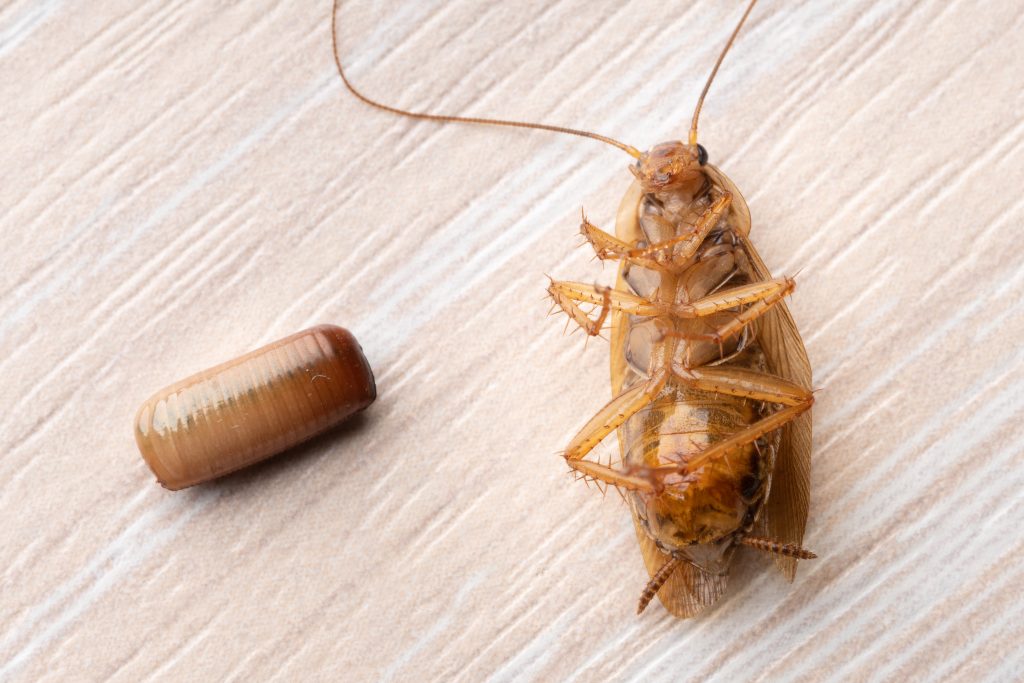
The Three Life Stages
German cockroaches undergo incomplete metamorphosis. Their life cycle has three stages: egg, nymph and adult. They do not have a pupal stage.
1. Egg Case or Ootheca
Female German cockroaches produce an egg case called an ootheca. Each ootheca commonly contains around 30–40 eggs, although the number can vary.
Unlike many other pest cockroach species, the female German cockroach carries the ootheca attached to her abdomen until the eggs approach hatching. She then deposits it in a sheltered location shortly before the nymphs emerge.
This behaviour can protect the eggs from some treatments that rely on direct contact. However, the exact effect depends on the insecticide, application method and whether the treatment reaches or kills the female carrying the ootheca.
- Approximate duration: around three to four weeks under favourable conditions
Temperature and other environmental conditions can shorten or extend the development period.
2. Nymph
Newly hatched nymphs are small, wingless and generally darker than adults. They remain close to suitable food, moisture and harbourage.
As they grow, nymphs shed their exoskeleton several times before becoming adults. Warm temperatures and reliable access to food and water can speed up their development.
- Approximate development time: often around 40–60 days under favourable indoor conditions
Development may take longer when temperatures fall or food and water become limited.
3. Adult
Adult German cockroaches measure approximately 12–15 millimetres long. They are amber, light brown or tan and have two dark, lengthwise stripes behind the head.
Adults have wings but do not appear to fly. Females can produce several oothecae during their adult lives, allowing populations to grow quickly when food, water, warmth and shelter remain available.
Why the Life Cycle Affects Treatment
A treatment may affect exposed adults and nymphs while some egg cases remain protected inside harbourages or attached to females. As a result, nymphs may appear after the initial service.
This does not automatically mean that the treatment has failed. Instead, the technician should use monitoring results to determine whether the population continues to decline or requires further treatment.
A common sequence may include:
- The initial treatment reduces exposed adults and nymphs.
- Egg cases that survive may hatch later.
- Newly emerged nymphs encounter bait or treated harbourage areas.
- The technician checks activity and reapplies treatment where necessary.
Treatment plans should not use a fixed visit schedule for every property. Registered cockroach-bait labels commonly instruct technicians to inspect bait placements periodically and reapply the product as needed. Some labels recommend checking treated areas approximately one month after the initial treatment or more frequently during heavy infestations.
How Quickly Can an Infestation Grow?
German cockroaches reproduce faster than many other common pest cockroach species. Victorian health guidance reports that they may complete three to four generations per year, while development from hatchling to adult can take as little as approximately 40 days under favourable conditions.
Because several generations can overlap, a small population may become a substantial infestation if the property continues to provide food, water, warmth and protected harbourages.
However, population growth does not follow one fixed doubling rate. Temperature, food, moisture, crowding, pesticide exposure and insecticide resistance can all affect reproduction and survival.
What This Means for Your Treatment Plan
An effective German cockroach control plan may include:
- Inspecting kitchens, bathrooms, appliances and other harbourage areas
- Identifying the species and extent of the activity
- Applying registered gel baits, dusts or insecticides where appropriate
- Monitoring bait consumption and cockroach activity
- Reapplying treatment when inspection results show that it is necessary
- Removing food residue, grease and accessible water
- Repairing leaks and reducing clutter
- Sealing suitable cracks and crevices
- Managing insecticide resistance through appropriate product selection
A single service may resolve some small or localised infestations. However, established or widespread activity may require additional monitoring and treatment. The technician should base that decision on the infestation, treatment method and results rather than applying the same number of visits to every property.
Want a treatment plan based on the infestation and the German cockroach life cycle? Contact Newcastle Pest Exterminators to arrange an assessment and request a quote.
